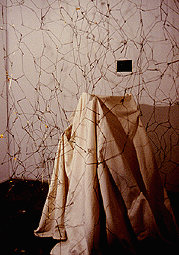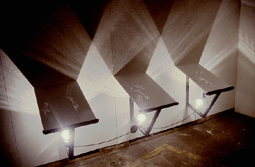
The immediate goal of this work is to consider the object-place-self relationship. The impetus lies in an idealistic quest for the "authentic" and in reaction to the reduction of objects and places into homogeneous surfaces. transformations / reclamations
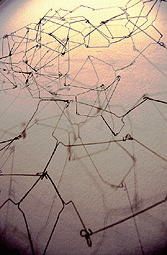
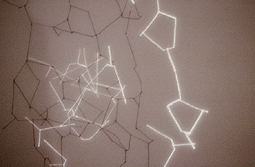
Objects and places are centers of value. They attract or repel in finely shaded degrees. To attend to them even momentarily is to acknowledge their reality and value. 1 One attempt to create a substantive expression is made through the transformation of a discarded, manufactured object. Clothes hangers were modified to create a fragile and mutable net or web. The discarded object as starting point is a simple gesture in response to a culture that denigrates resources. This disregard can only be morally justified by denying that human life is only part of a larger natural existence and by embracing a techno-corporate imagined immortality. This small proposal is reasserting our organic reality and the evanescence and interconnectedness of all things. the body as vessel
...the body itself is necessarily exaggerated as soon as we have an image of the body, an image which is a projection or objectification of the body into the world. Thus the problems in imagining the body are symptomatic of the problems in imagining the self as place, object, and agent at once. 2 Spaces and places as vessels containing the body is a resonant concept because the body itself is a repository and vessel. One understanding of the relationship between body and space might begin with a kind of empirical investigation of intimate space; in this project, the space just beyond clothing is of interest. Also, this approach assumes that the vitality of human presence and action is the origin of "place." Only through respect can we begin to learn from the body as a source of knowledge.
1. Yi-Fu Tuan, Space and Place (Minneapolis: University of Minnesota Press, 1977), p.18.
|