| The following selection of projects, 1993-the present, attempts to frame a non-instrumental approach to architecture. Commercial work and projects for private clients are not represented in the set.
|
|
|
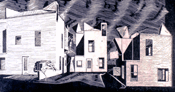
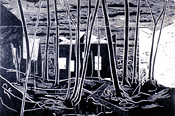
[Pittsburgh Housing] This competition project for low-density housing in Pittsburgh, developed with William Wilson, sites the houses around loosely defined courts. These spaces could be appropriated by the neighbors collectively, partitioned into individual yards, or left in a wild and untended state. A project for ten houses in Detroit conceived in a similar way is now under construction.
In these examples, the act of siting and arranging literally forms spaces for the community. I hope that these spaces would have a familiar spirit -- that they'd transpose the sense of emptiness, the openness and spatial generosity which, oddly enough, arises from abandonment and neglect, in parts of the Bronx, Pittsburgh, East Detroit, and so many other American cities.
|
|
|
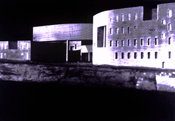
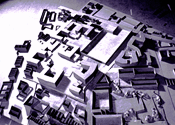
[Brooklyn High School / Day Care Center / Community College] With the help of Bill Sharples, Galia Solomov, Anna Liu, and Kwang Paik, I made this proposal for a high school / day care / community college in Brooklyn. The neighborhood is rough, and something built without the residents would have little chance of physical survival. So I proposed that the construction method involve both union and local non-union labor. One team would erect bearing walls of oversized precast concrete elements, dry-laid and post-tensioned; and another team would follow up, even a year later, infilling the cells of the original wall with brick and block.
The site borders a residential and an industrial area. The neighborhood, Bushwick, is one of the poorest in New York. Along with the schematic proposal for an additional high school, we made a master plan for an adjacent community college, using typical New York City programming requirements.
|
|
|
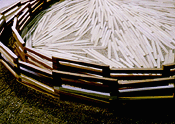
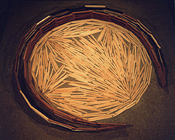
[Idlewild Monument] If the community were involved, an act of
"building" might become an act of "founding."
This is one the hope of a project in Idlewild, Michigan. Idlewild
was the largest African-American summer resort, an important meeting
place and jazz venue, which fell onto hard times after the civil
rights movement and is now being revitalized. A local community
organization requested some kind of entrance marker or monument
which could guide and orient visitors, and hold community events. On
a corner site where Idlewild's Broadway meets a state highway, I'm
proposing to mark out a clearing roughly 40 feet in diameter,
surrounded by a double wall four feet high.
Reminiscences about Idlewild will run along the inside face of the inner wall. One can follow each quote from beginning to end, as its text runs from member to member, but parts of one quote may also entangle another: "...one could feel oneself, for the moment, truly....then somebody's cousin from Detroit or Chicago.... dancers reached the point they called the "breakdown".... to make a difference, for justice...."
Both the wall and the slightly bowl-shaped clearing will be made of square "logs" of unglazed clay, fired and reinforced, five inches square by six feet long. As paving for the clearing, these members will be gathered together in an irregular pattern, like logs in a log jam. Some of the pavers will bear the name of an existing landmark; most will be blank. The wall will be made by stacking the members with large gaps between them. Members which make up the outer wall will be of four colors of clay: red, white, black, or yellow. The interior wall will be made in the same way but of different shades of the black or brown clay. The inner ring will rise a little higher, to a level top course.
These projects attempt to find their freedom by working "on the periphery," on less contested sites. Another approach is to concentrate upon those building types which still have a measure of open-endedness, as Kahn advised. Why are most of the noteworthy works of contemporary architecture museums or chapels? Because society still recognizes that what goes on in prayer or in looking at artwork is essentially unformalizable.
|
|

|
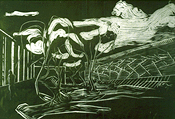
[Estonia Museum of Art] An example of such a program, from my own work, is a competition entry for the Estonian Museum of Art, prepared with Dania Saragovia, Bill and Chris Sharples, Cory Denningham, and Dagmar Frinta. We laid out the museum as a set of galleries, trailed across the slope of an old hunting park.
In Tallinn, the sun is never more than 28 degrees above the horizon. There are few consecutive sunny days-- so when the sun breaks through it's an important moment and not something to miss because you're in a museum. Even on typical grey days, I think it would be problemmatic to be wandering around in a flat- or low-ceilinged space. Our museum offers psychological relief from the cloud cover. Each gallery is covered by a lightly etched glass vault, which seems opaque and luminous in direct sunlight, and transparent when in shadow. Because you can see through the vault to the underside of the roof above, you have a sense of a lower sky layer opening up to a higher layer.
The vault in each of the galleries is hung from a wood lamella structure. For each gallery, all the beams of the lamella are inclined to a given sun angle. At one moment (if it happens to be sunny), the beams cast only their edge-shadows onto the vault below. At any other time, the beams cast a complex shadow-shape onto the vault. The time of day when the beams cast their edge shadow is different from gallery to gallery. The sun follows its own path through the museum, so to speak.
One can work outside the contested zone; one can work on traditional non-utilitarian programs; one can also concentrate upon research. This has usually been the path of the avant-garde. Are there approaches to building which could increase the measure of open-endedness? One could propose new paths for design or realization which, by their nature, might introduce latitude into the building process. In a few projects for new urban districts, I've tried to imagine how a set of growth-rules and a formal procedure for resolving questions could replace master plans, lot divisions, and other a-priori planning documents.
|
|
|
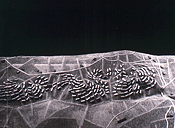
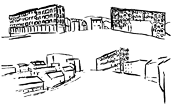
[Comillas Settlement Proposal] These general ideas were carried forward in a proposal for a new settlement in Comillas, Spain, which I worked on with Dagmar Frinta and Kenta Kishi. The west slope of a large valley near the village of Comillas is used for cattle grazing; the new owner wishes to build a suburban-style subdivision instead. In our counterproposal we promoted a more urban neighborhood, which could better preserve the existing agricultural use. The growth-rules in this case took account of the contours of the land.
At the top of three knolls, beside the old farmhouses, we located three small squares or clearings, to be encircled by mixed-use buildings in a radial layout. The gaps between these radiating buildings become starting-points for a number of possible roads. Any new house built in the valley would have to front upon an extension of these roads. We specified their permissible grade-- between ten percent and twelve percent, descending clockwise down the valley-- and also specified a minimum distance that the roads must be spaced from each other, measured perpendicular to the contours. Given these rules and the terrain, whose slope increases in steepness as one approaches to the valley floor, the roads would trace irregular widening spirals as they extend down the hill. We hoped that these sweeping clearings between the rows of houses could continue to be used as grazing land. At the end of each day, the cattle would be driven back up the hill through the town square to the farmhouse.
These projects try to reintroduce a field of judgment, attention, and uncertainty into the process of building. They would directly confront the utilitarian, instrumental, calculating thinking that I believe is destroying the practice of architecture. I've pursued this agenda in other projects, especially at the scale of detail and construction methods.
|
|
|
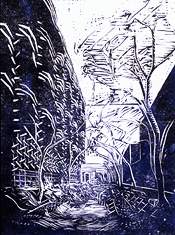
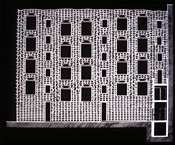
[Paris Apartment Building] One of these was a proposal for a small apartment building in Menilmontant, Paris, prepared with Dagmar Frinta. Beside the corner site is an empty lot, which we annexed as a garden. I proposed that the exterior walls be built of special dry-laid precast concrete units. The units are "eccentric"; one of the two legs is shorter than the other. If the units are stacked repetitively, they form regular horizontal courses. Stacked in a non-repetitive way, they form parabolic arches over the window openings. The question of how to lay these units, ultimately the choice of a left-hand or right-hand orientation for each block, is left to the mason on-site. This could be a kind of craft-work, one which requires judgment like the old building methods, but which coexists with the modern mode of construction which is dry assembly. The cells between the dry-laid units would be filled and stabilized with mortar and rubble brick.
The facing method also accommodates a free pattern of window openings and sizes. In this building major spaces have a 3.6 meter ceiling height and minor spaces have a standard 2.7 meter ceiling height. This 3:4 shift allows for a great deal of flexibility in the internal subdivision of the units, among other benefits; it also scatters the window elevations across the facades.
|
|
|
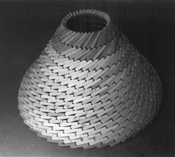
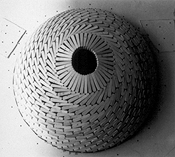
[Masonry Dome Prototypes] In another masonry project, research on methods of dome construction, the "eccentricity" took another form. Bricks which are slightly tapered in plan and in section, with rounded ends, lay up with a tendency to form a dome. This brick solves one of the most obvious problems of dome construction, namely, how to maintain the same number of bricks and the same size brick from one course to the next.
Depending upon the "rule-of-thumb" the mason observes when laying this brick, the resulting dome can be hemispherical, trumpet-shaped, ogee, oblate, or paraboloid, all without centering.
|
|

|
[Prague Pheasantry competition] Finally, as another example of this way of building, I'll show you a competition entry which Dagmar Frinta and I prepared for a new public garden in Prague, just north of the Castle. The site, historically the Castle's vegetable garden, was treated roughly over time. Someone dumped an electrical substation on it. Dagmar and I proposed, among other things, to build a new public square over the substation, paved in tapered bricks like the ones I just described. The resulting pattern has spiraling "brush strokes" which converge on different centers, which I scattered more or less randomly across the square. This new public space would be bounded to the east by the Renaissance Riding Hall; to the north by a restaurant; to the west by a pavilion; and to the south by a perforated wall. The square, the wall, and the pavilion would all be formed of repeated elements, gathered together to form a larger-scale order without a grid or other simple repetitive pattern.
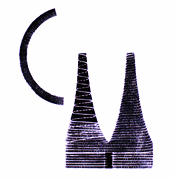
The pavilion to the west, for roasted chestnuts in winter and ice cream in summer, would also disguise the vent stacks for the substation. We proposed a substructure of sheet metal. It turns out that a band with a constant radius-- which, in our case, would be formed by continuously crimping one edge of a roll of sheet metal-- when coiled, forms a trumpet-shape. We ganged six of these trumpets together, and modified some into "bottle" shapes. Because the surface of these towers are developed in a simple way, they can be tiled in a simple way. We proposed to cover the six-towered pavilion with three sizes of slate shingle.
|